Artificial environments
To further simulate natural surroundings an environment may have branches or vines. With that it is important to note that certain plants are poisonous to Sugar Gliders, but there are plants that are safe to have in a sugar glider environment.
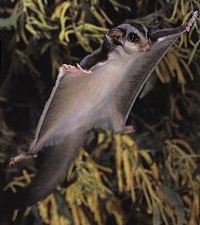
Unlike many native animals, particularly smaller ones, the Sugar Glider is not endangered. Despite the massive loss of natural habitat in Australia over the last 200 years, it is adaptable and capable of living in surprisingly small patches of remnant bush, particularly if it does not have to cross large expanses of clear-felled land to reach them. Several close relatives, however, are endangered, particularly Leadbeater's Possum and the Mahogany Glider (which, to the non-expert, looks almost exactly like a Sugar Glider).
The Sugar Glider is protected by law in Australia, where it is illegal to keep them as pets, or to capture or sell them without a licence (which is usually only issued for research).
The Sugar Glider can occupy any area where there are tree hollows for shelter and sufficient food. Its diet varies considerably with both geography and the changing seasons, but the main items are the sap of acacias and certain Eucalyptus, nectar, pollen, and arthropods. It is difficult to see in the wild, being small, wary, and nocturnal, but a sure sign of its presence is the stripping of bark and tooth marks left in the soft, green shoots of acacia trees.
In suitable habitats it is common, often reaching densities of 1 per 1,000 square metres provided that there are tree hollows available for shelter. It lives in groups of up to seven adults, plus the current season's young, all sharing a nest and defending their territory. Adult males mark the territory with saliva and with scent glands, and also mark members of the group with the scent produced by separate glands on the forehead and chest. Visitors which lack the appropriate scent marking are expelled violently.
The dominant male mates more frequently with the female of the group than the other males, and does most of the scent marking. When an adult member of the group dies, it is normally replaced: by one of the group's own offspring if female, but by an outsider if male.
In the more temperate south, breeding starts in mid-winter (June or July). In the north, there seems to be no particular breeding season. Two young per female is typical; they remain in the pouch for about 70 days, and after leaving it stay inside the nest for another 40 or 50 days, then begin to forage outside, usually under the care of the mother. The young are normally ejected from the group territory at 7 to 10 months of age. Sometimes they form new groups if an area is vacant, but competition for territory is fierce and not many survive the first months of independent life. In captivity, they may live up to fifteen years.
Reference: http://en.wikipedia.org/wiki/Sugar_Glider