The Rainbow Wildlife Rescue has moved to Little Elm, TX. We do NOT accept animals for rescue but are changing venues and are focussing on education only. READ MORE HERE >>>
Wildlife Rehabilitation is not only about Cute Animals:
Some States do not have an official list or directory of licensed wildlife rehabilitators or wildlife centers and organizations, therefore these links will point to one of the larger online directories.
WARNING: It is illegal in most US States to possess wildlife, regardless if you want to just help them, without a rehabilitation permit. Even then you can't keep "it", because the main goal is to release them back into the wild. Having a native wild animal is considered a misdemeanor crime and will be punished with hefty fines and usually results in the animal being confiscated and killed! So, if you love them, leave them alone or call a licensed wildlife rehabilitator or center if you believe that they are in need of human help.
If you find a Baby Bird:
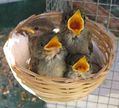
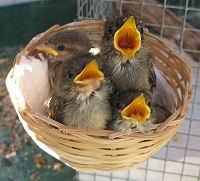
Many baby birds are found by people and taken in to be cared for. People believe the baby bird has been rejected by its parents, is lost, or can not get back into the nest. This is 99% of the time not the case.
The fatality rate of baby birds that are taken in by kind-hearted individuals is unfortunately very very high.
Many people ask if a baby bird will be rejected by its parents if a person handles them and the parents will smell the human scent on them. This is just an "old wives'" tale. In fact, most birds have a very poor sense of smell or are incapable of smelling at all.
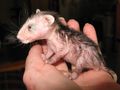
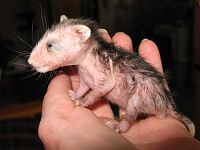
DO NOT raise an infant opossum if you do not know what to do! It is also illegal in most States!
Most opossum babies end up orphaned, because their mother was hit by a car (their only real defense is to play dead...) or killed by dogs and many other reasons..
So PLEASE, if you care and you happen to hit an opossum with your car - accidents happen - take a minute and make sure that there are no surviving babies inside mom's pouch. After all, they are America's only Marsupials.
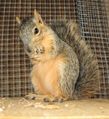
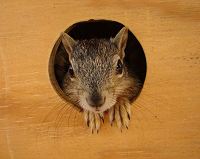
Baby squirrels sometimes fall out of a nest that has been damaged in a storm or for many other reasons.
The squirrel may not be an orphan at all, but may have just fallen from its nest. If there is one, chances are that there are others having suffered the same fate as well.
It is recommended that you warm up the baby squirrel (if cold) by holding it close to your body and then place it at the base of the tree it has fallen from.. Given time and provided you staying out of sight, the mother will return and retrieve her baby.
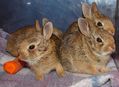
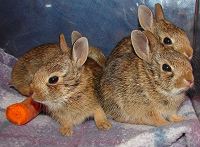
Most baby cottontails end up in human care for all the wrong reasons even though the heart of the rescuer was surely in the right spot and their intentions honorable and motives kind.
If you come across a nest of bunnies in the wild and the mother is nowhere in sight, please DO NOT disturb them! Mom only comes twice a day for a few minutes to feed them, that's it. They are most likely not orphans.
By removing them from the nest you are greatly reducing their chances of survival.
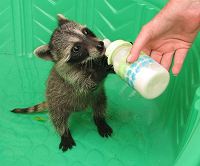
If you find orphaned babies please do not try to feed them. Keep them warm and get them to a licensed wildlife rehabilitator as quickly as
possible. Fed incorrectly these little ones can aspirate [inhale formula into
their lungs] and die.
Even as they get a little older we still must be careful
to match their mother's milk and their diet as it would be in the wild. Their
systems are delicate at this age and they do not have the ability to digest
many of our foods.
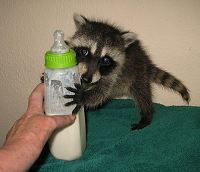
If you do find what you believe to be an orphaned kit, please, don't just
snatch it up. We first need to make sure that it is indeed an orphan. Many
babies play while mother is sleeping in a tree. Mother is nocturnal, but
babies are not.
Found an orphaned animal?
Find out how to determine if it needs your help or not!
Wild animals of all shapes and sizes are born during the spring and summer months. In your own backyard, you may come across baby birds, rabbits, squirrels, opossums, and other young wildlife as they make they make their way into the world.
For many people, the pleasure of seeing these young creatures is mixed with a sense of protectiveness—of wanting to help them survive. Spotting a baby animal by himself doesn't necessarily mean he's an orphan. Many wildlife parents leave their young alone during the day, sometimes for long periods. The parent is usually nearby and quite conscious of her young. Also, keep in mind that, despite their small size, many young animals are actually independent enough to fend for themselves.
How can you tell if an animal needs your help or should be left alone? Here are some general signs to look for:
A wild animal presented to you by a cat or dog
Bleeding
An apparent or obvious broken limb
A featherless or nearly featherless bird (nestling) on the ground
Shivering
Evidence of a dead parent nearby
If a wild animal exhibits any of the above signs, you should immediately call one of the following local resources for assistance. You will find listings for most of these in your telephone directory.
Unless one or more of the signs mentioned above is present, do not attempt to rescue animals in any of the following circumstances. Here are a few examples of situations you are not required to intervene:
A bird who is fully feathered on his body with evidence of tail feathers, hopping on the ground, but unable to fly. This is a fledgling (adolescent bird), and his parents are probably nearby.
A rabbit who is four inches long with open eyes and erect ears. She is independent from her mother and able to fend for herself.
An opossum who is nine to ten inches or longer, not including the tail. He is independent.
A squirrel who is nearly full sized, has a full and fluffy tail, and is able to run, jump, and climb. She is independent.